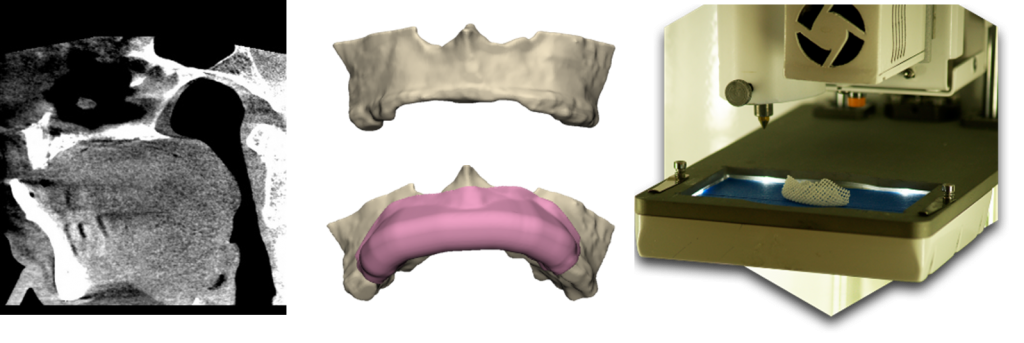
Rasperini, G., Pilipchuk, S. P., Flanagan, C. L., Park, C. H., Pagni, G., Hollister, S. J., & Giannobile, W. V. (2015). 3D-printed bioresorbable scaffold for periodontal repair. Journal of dental research, 94(9_suppl), 153S-157S.
Teo, L., Teoh, S. H., Liu, Y., Lim, L., Tan, B., Schantz, J. T., & Seah, L. L. (2015). A novel bioresorbable implant for repair of orbital floor fractures. Orbit, 34(4), 192-200.
Park, Y. J., Cha, J. H., Bang, S. I., & Kim, S. Y. (2019). Clinical application of three-dimensionally printed biomaterial polycaprolactone (PCL) in augmentation rhinoplasty. Aesthetic plastic surgery, 43, 437-446.
Korn, P., Ahlfeld, T., Lahmeyer, F., Kilian, D., Sembdner, P., Stelzer, R., … & Gelinsky, M. (2020). 3D printing of bone grafts for cleft alveolar osteoplasty–in vivo evaluation in a preclinical model. Frontiers in bioengineering and biotechnology, 8, 217.
Schantz, J. T., Lim, T. C., Ning, C., Teoh, S. H., Tan, K. C., Wang, S. C., & Hutmacher, D. W. (2006). Cranioplasty after trephination using a novel biodegradable burr hole cover: technical case report. Operative Neurosurgery, 58(1), ONS-E176.
Probst, F. A., Hutmacher, D. W., Müller, D. F., Machens, H. G., & Schantz, J. T. (2010). Calvarial reconstruction by customized bioactive implant. Handchirurgie, Mikrochirurgie, Plastische Chirurgie: Organ der Deutschsprachigen Arbeitsgemeinschaft fur Handchirurgie: Organ der Deutschsprachigen Arbeitsgemeinschaft fur Mikrochirurgie der Peripheren Nerven und Gefasse: Organ der V…, 42(6), 369-373.